
John Aldridge’s Experiences
While Dudley and Jim talked of panhard rods and things (February) by coincidence I had already embarked on a similar course on my ‘M’ Type, having salvaged a rod and bracket from my spare P1 chassis.
All was as Dudley described but . . !
First the fabricated bracket from the P1 was located on the front flange of the main rear crossmember. Second the linkage to the radius arm was a welded bracket (see figure 1) with a centre below the spring anchorage.
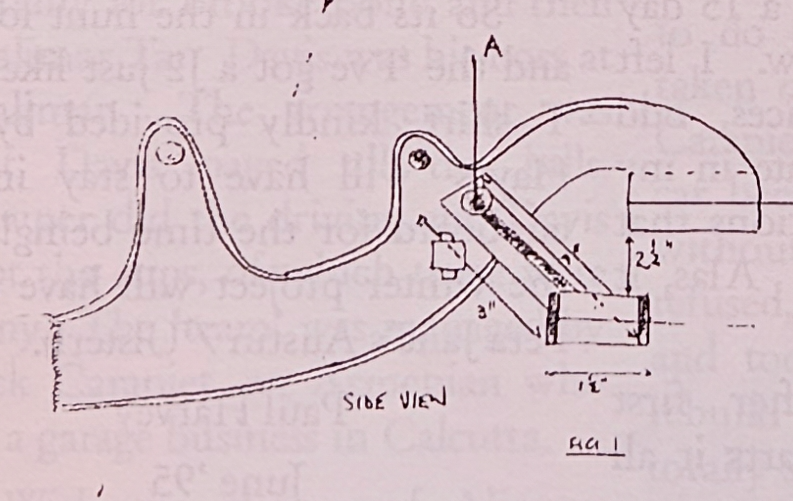
This conforms with the description in Newnes Motor Repair (Vol. 1) which indicated that the early set ups used a bolted link to the off side radius rod end but a welded bracket was employed on later models (see figure 2).
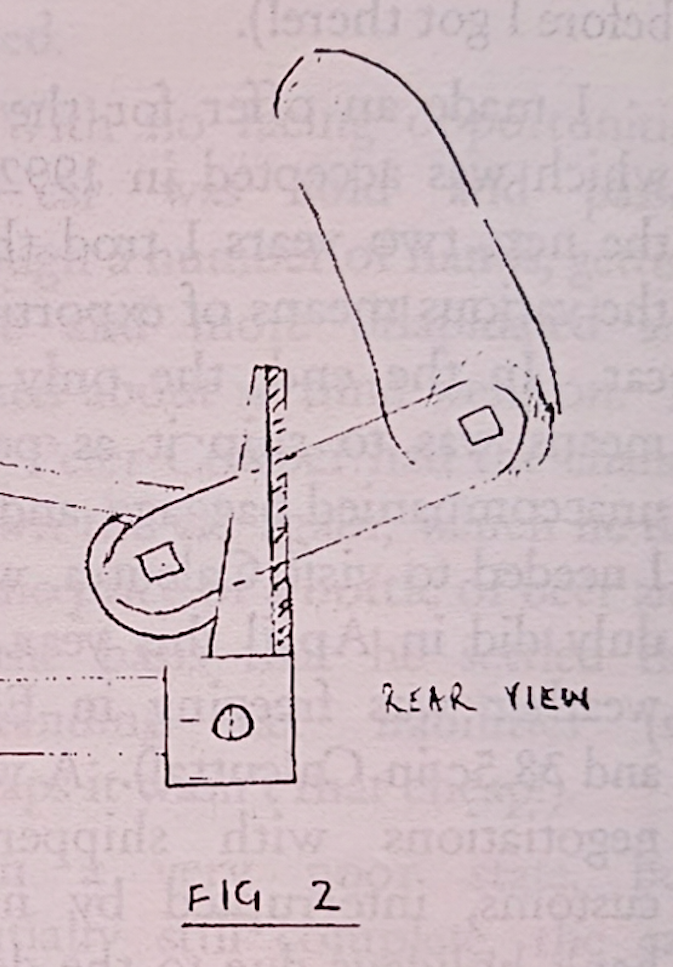
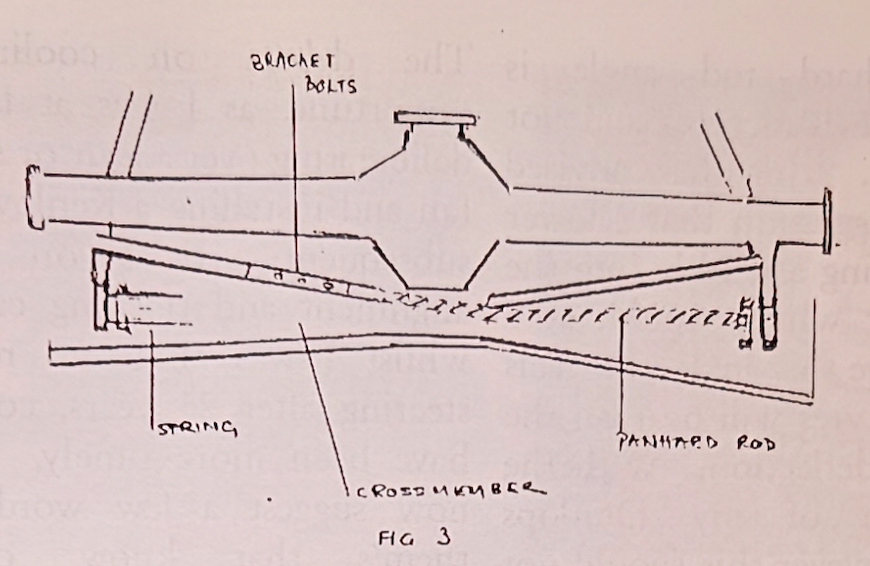
As a consequence the rod was led differently requiring ‘some bending’ to avoid the differential casing (see figure 3). It was still necessary to align the bosses to be square and parallel. NB I have never won prizes for technical drawing!
I found that a Saab panhard rod was almost a dead fit both in size of silentbloc bush and its length. My own imprecise engineering skills prescribed that the use of bosses and bolts required the construction of the new rod although I improvised with the original Allard rod due to its substantial robustness and a spare track control arm from the P1 on much the same lines as described by Dudley in his article. I believe that were it not for the lack of substance the SAAB rod could have been used in its entirety – but it was not designed for Allard ‘stresses’.
Now one drawback to this arrangement is the frailty of the cross member where the bracket is located. On my original P1 the leading-edge of the rear cross member had cracked and broken off due either to flexing when under load or perhaps stresses created by loose securing bolts on the bracket. It would therefore be prudent to beef-up the area of stress by welding on a plate or at least locating the bolts through a stiffening plate to spread the loading.
I have now covered 650 miles under this new arrangement (including some ten on the Silverstone Grand Prix circuit) and the handling is certainly different. Gone is that curious but reliable oversteer and in return is a more predictable steering characteristic which demands the application of power when exiting corners to be most effective.
I should add that I have employed the slightly stiffer P1 rear spring on the M type and have replaced its hangers with a new set from Wally Wheatley. Further the engine mounts and the steering ball joints have all recently been replaced. Any sloppiness must lie in the steering box. That’s next!
Ed. We already have Dudley’s reply to this article which you can read here