
Dudley Hume was an engineer who worked closely with Sydney Allard during an important period in the company’s development. His work included suspension design and development, and he was directly involved in discussions around the divided-axle front suspension used on many Allards. His first-hand recollections therefore provide a particularly valuable insight into the engineering decisions, personalities and thinking behind the cars.
This is his response to an article by John Aldridge which you can read here
As Mr John Aldridge had the courtesy to send me a copy of his piece on Panhard Rods I would respond as follows:-
Firstly the sketches accompanying my article were not intended to be precisely as the P1 installation, but a stylised version to give a general picture of what a panhard rod is all about.
As I discussed with J.T. at the time it was intended that members should ‘work out’ their own installation. The point being that the P1 chassis is much higher than the open models and the track 6 inches greater so the circumstances are a bit different.
However, I have to say that as I hadn’t actually looked at a P1 installation since shortly after I designed it 44 years ago I had forgotten that the chassis bracket was mounted to the front flange of the cross member. My apologies for any confusion that might have been caused.
John Aldridge’s comment about the failure of the front flange on his P1 chassis is very interesting. On Sydney’s Monte P1 we welded some vertical fillets between the flange and the side of the cross member to stiffen this up as per sketch.
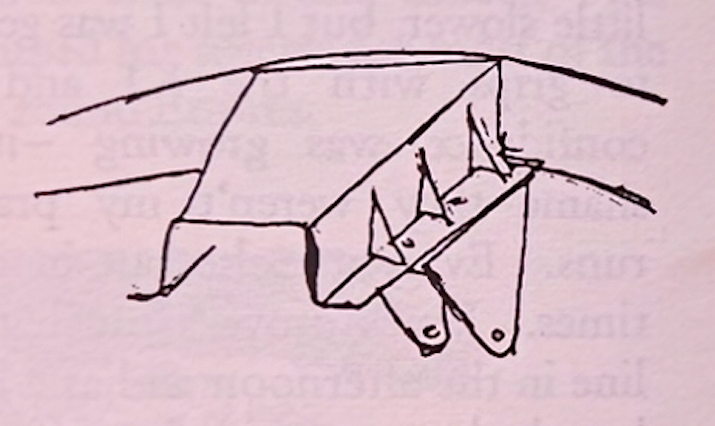
However, for production it was decided to omit these, primarily for cost reasons, but it was also considered unnecessary for normal use. Perhaps as John Aldridge suggests the bracket on his chassis was allowed to come loose. But also, as he suggests, it may be a good idea to ‘beef up’ this area.
There is one point however, about John Aldridge’s installation on which I must comment – 10 degree installed angle is much too great. At this angle it will thrust the axle over relative to the chassis on almost any O.S. bump. Apart from a feeling of uncertainty it will shorten the life of the panhard rod bushes. 2 – 3 degrees is really a maximum that can be tolerated without adverse effect. However it seems that his proposal to lift the outer end could be the best answer provided it doesn’t foul anything on full bump.
Concerning John Aldridge’s plea for details of a master cylinder conversion to have a reservoir on the bulkhead, I would first of all advise strongly against actually modifying the master cylinder. I don’t think he meant that but in case it is misconstrued I felt it advisable to point this out.
The best way to overcome this problem is to obtain a master cylinder with the identical piston diameter and at least as much travel as the existing one but designed for a separate reservoir.
The identical piston diameter is important. If a master cylinder with a smaller piston diameter is used it will give a lower pedal effort, but the pedal travel will be increased and this could be to the point where it will ‘bottom’ before maximum braking effort is reached.
If a master cylinder with a larger piston diameter is used this will result in increased pedal effort and could be too high for the driver to achieve maximum braking effort.
The difficulty nowadays is finding a ‘single’ master cylinder without the plastic reservoir mounted on it.
It will be a very complex, time consuming business locating a suitable master cylinder unless luck takes a hand and of course if anybody has found, or does find such an item, perhaps they will let the membership know about it.
Dudley Hume