
This article is reproduced from an earlier Allard Owners Club magazine and reflects one owner’s experience of diagnosing and repairing a period fuel pick-up unit.
Please treat it as historical information rather than current technical advice. Fuel systems involve obvious fire and safety risks, and anyone carrying out similar work today should use appropriate modern materials, procedures and professional guidance where necessary.
For the past two or three years I have had a steadily worsening problem in that I appeared to be running out of fuel while the fuel gauge still showed that I had plenty left. In the beginning the gauge would be showing about ¼ full, but it got steadily worse until at the end of last year I was running dry with the gauge showing just over half full! Unfortunately, the reserve knob has been inoperative since I bought the car, so I couldn’t experiment with that.
I found that the fault, or more correctly faults, were all to do with the pick-up, which those of you who have had your own off will know is one of Joe Lucas’s (The Prince of Darkness as he is known in the motorbike fraternity) lesser efforts!
The unit consists of two 7/32 inch pipes, one about an inch longer than the other, which hang into the tank, supported by the unit itself which bolts to the top of the tank. The idea is that under normal conditions the pump sucks through both pipes until the level of fuel in the tank falls below the end of the shorter primary pipe. This then starts to suck air, giving the effect of having run out of fuel. When the reserve knob is pulled, the solenoid coil in the unit is activated and the solenoid moves forward, which in turn pushes a small ball bearing forward against a spring, which normally holds it open, sealing the exit of the primary pipe. The pump is now only pulling from the longer (reserve) pipe, the extra length of which gives about 2 gallons on an Allard.
Armstrong Siddeleys use a similar unit and speaking to their spares secretary he told me that they have 4 regular faults, in order of frequency:-
- Sticking ball bearing.
- Broken live wire leading to the solenoid coil.
- Splits in the pick-up pipes.
- Broken wire in the solenoid coil winding itself.
I had managed to score two out of four of this list. Firstly, the live feed wire had broken away from the coil, which was fairly easily repaired. The second however, proved to be a bit more difficult. The 7/32 inch pipes are brass (as opposed to copper) and are seamed. It is the seam that splits and in my case the primary pipe was split from the bottom to roughly half way up, hence my running out of fuel with the tank showing half full. At this point I took the whole thing to an engineer friend for advice and help.
We could not find out how the pipes fit into the casting of the unit itself, as although they turn, they don’t seem to be screwed and nor do they pull out. Replacement was therefore not possible. (in any case 7/32 brass pipe is unobtainable). Armstrong Siddeley’s recommended repair was to run petrol tank sealant along the split but we both felt that this was a bit Heath Robinsonish. My friend’s solution was to twist both pipes so that the seams were facing one another, crimp the pipes together and then fill the very narrow gap between them with silver solder. This not only sealed both seams, but also strengthened any potential flexing. It had the added advantage of annealing the brass in the process.
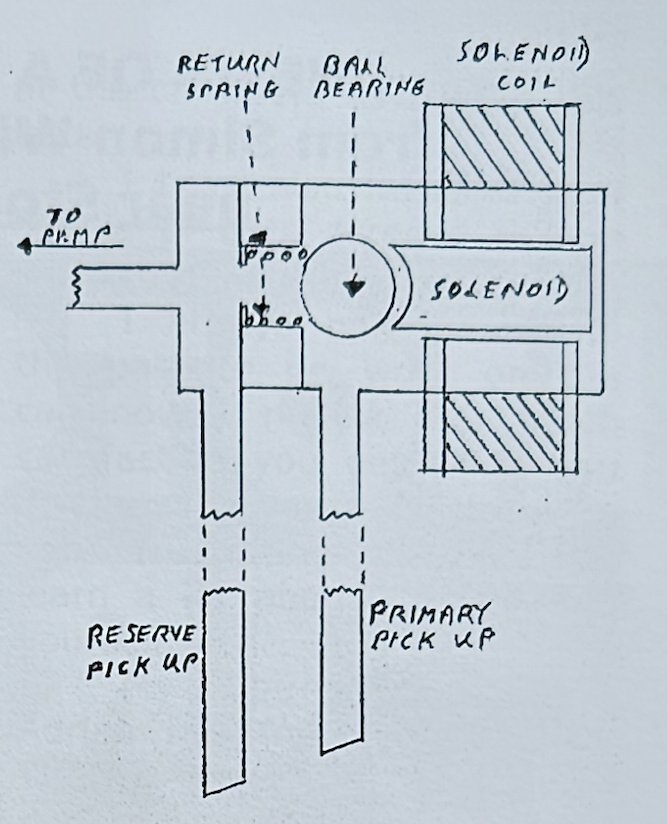
The last inch at the top, where the pipes enter the casting, could not be soldered, firstly in case the heat cracked the casting and secondly, because the pipes could not be crimped together in this area due to their positioning in the casting. In this area he forced a strip of plastic sponge between the pipes and soaked it with 2 part fibre glass resin. He then wound heavy duty linen thread (welted shoe sole stitching thread) around both pipes, pulling the ends through and knotting them and soaked the lot once again in fibre glass resin. The complete unit was then propped up with the pipes upright, allowing the resin to soak down into the joins of the pipes into the casting. The Prince would have been proud of the result! It works perfectly.
Peter Wright