Dudley Hume was an engineer who worked closely with Sydney Allard during an important period in the company’s development. His work included suspension design and development, and he was directly involved in discussions around the divided-axle front suspension used on many Allards. His first-hand recollections therefore provide a particularly valuable insight into the engineering decisions, personalities and thinking behind the cars.
This article was taken from an old Tailwagger article and is reproduced exactly as written.
Zora Duntov’s primary reason for joining Allard was to develop the Ardun conversion which Sydney was very interested in and hoped it would solve his “power” problem.
The first components which Zora had sent over for the test programme i.e. rockers, pushrods etc. were of sub-standard material and very quickly deteriorated, cups wore out and pushrods became bent. One of the problems however proved to be the size and weight of the pushrods and the rocker arms which caused very high inertia loading at high revs (one of the problems when a conversion to an existing design is attempted). The specs were increased, but they still failed after prolonged runs at high speed. An engine tuning specialist was called in who ventured the opinion that the only way the problem could be overcome was to have forgings for the pushrods which would have a larger diameter at the centre and taper to the ball cup ends and to be drilled right through to reduce weight. This would have been an expensive business which Sydney wasn’t happy about.
In the meantime “someone” had “imported” a Cadillac 5.4 litre unit which Sydney decided was a more promising proposition. Zora got to work on this but every time he increased the power something failed. Proving of course the efficiency of the original design. Eventually the hydraulic tappets were replaced with items machined from solid then the big end caps and connecting rods were upgraded and also the bearing shells, both mains and big ends. Zora succeeded ultimately in doubling the power output.
The suspension aspect was of course another story. When I joined the company I was told that the divided axle suspension was “invented” by Lesley Ballamy who held patent on it and that there was little that the company could do to change it without risking legal action. I knew this to be “baloney” because I had been studying the suspension subject for some years, whilst with Aston Martin, before joining Allard. An invention had to be new and novel to be patentable but research had shown that Daimler Benz had built a car in 1901 with divided axle suspension.
As the track was narrow and the wheels large and heavy the gyroscopic precessional torque proved to be disastrous. At around 1936/7 an American company produced a saloon car with a divided axle front suspension but in an effort to reduce the rate of wheel tilt on long travel (which determines the amount of precessional torque developed) the axle beam pivots were arranged on opposite side rails (i.e. they passed each other). This scheme was abandoned after a year or so however in favour of a double lateral link system.
Although I convinced Sydney that we could do what we wanted on the divided axle system without fear of legal action, and he agreed, after demonstration, to the “X” layout, I could not persuade him to let me design a wishbone, SLA, or double lateral link system (call it what you will). When Sydney asked me to design the J.R., the parameters he gave me, i.e. the same wheelbase and track as the MK1 Palm Beach but using the 16″ wheels (on a track which was 6″ less than the previous large cars, including the J2 and J2X). I felt that this could be a problem and endeavoured again to persuade Sydney to let me design a wishbone system. I had already schemed out an arrangement using the ball joints used on the Jaguar XK120 but with a different geometrical arrangement to give better cornering and roadholding.
Sydney very nearly decided in favour of the wishbone scheme for the JR but suddenly decided to stay with the divided axle system “because its my trademark so to speak”. The only thing I managed to persuade him of was to use light weight Borani wheels, at least on the front end to minimise the gyroscopic effect.
When the American marketing people ordered the MK11 Palm Beach chassis they wisely insisted on going away from the divided axle system to a McPherson system for this vehicle. I wasn’t very happy about it as the wing line was too low to accommodate a coil spring above the wheel so I proposed a torsion bar coupled by a link to the track control arm. The torsion bar I was obliged to incorporate in the design was a new idea consisting of four flat blades to form a square section bar. This was a promotional effort on the part of the manufacturer and was free of charge. I had to do what I could with it. Unfortunately the nature of the twisting, bending and friction was such that it proved virtually impossible to calculate its performance with any accuracy, so its use on motor cars was very limited.
However, the system worked OK and I believe is still working OK on the small number of vehicles built, probably with some maintenance. However, if Sydney had agreed to let me produce the wishbone system I had proposed for the JR we would have had a ready system for the MK11 Palm Beach. I had by this time left Sydney’s employ and was acting in a consultative capacity for this job.
About this time I completed the first of two articles on front suspension which were published in the Automobile Engineer. The first was on the divided axle system explaining its characteristics (I felt I owed this to Sydney in the hope that it would help a little as he was in serious difficulties). The second article examined the characteristics of all the other front suspension systems being used at that time with the emphasis on what I felt sure was the only really acceptable (wishbone) system, apart of course, from the McPherson system which as time has proved is the most satisfactory system for unitary construction cars with average wing lines, and required no adjustment on assembly, a big plus.
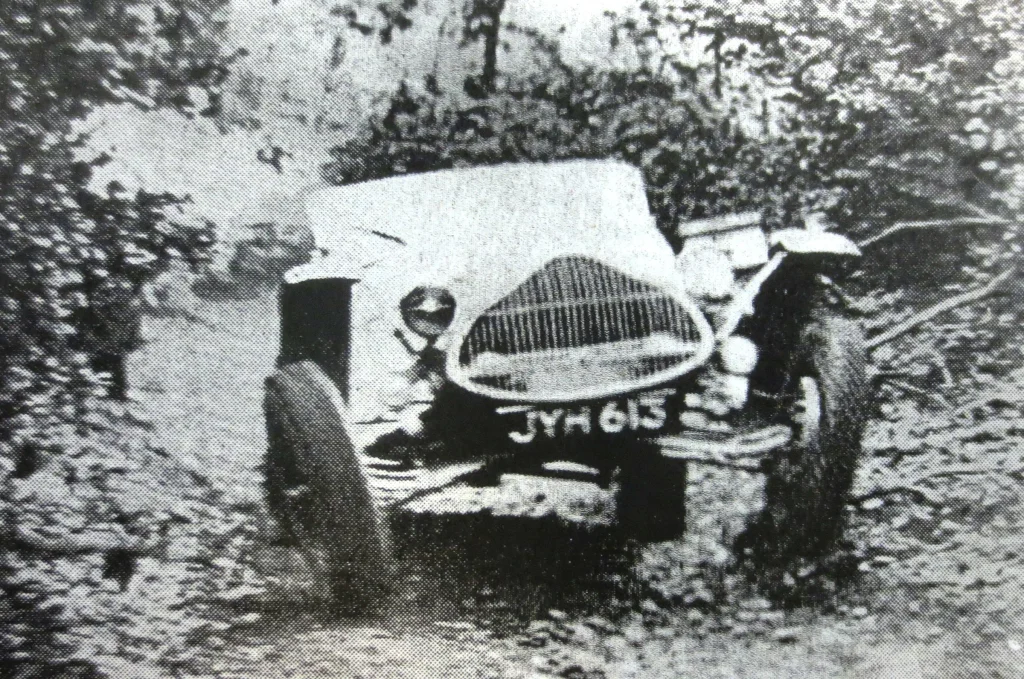
Dudley Hume.