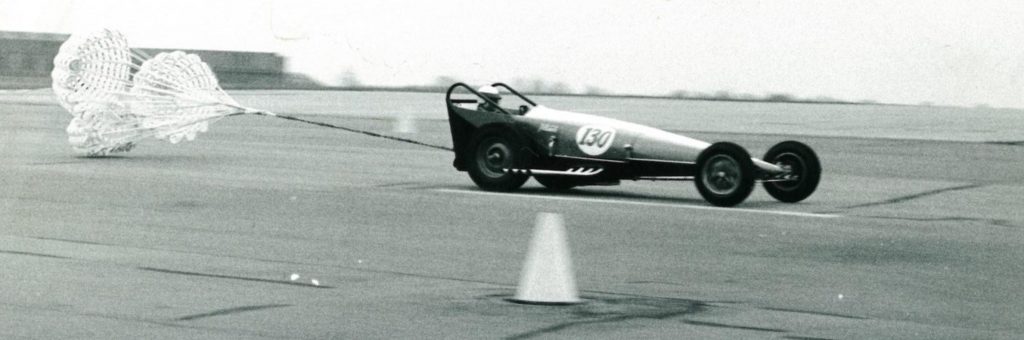
The rear axle was rigidly mounted and the front axle located with forward facing radius rods using a trans- verse leaf spring as the suspension medium. No shock absorbers were used. The inherent friction of the relatively stiff leaf spring providing adequate damping. Steering was via a centrally mounted Allard Marles steering box with an extended cross shaft and then via an intermediate idler located inline with the radius rod pick-up points. To satisfy The RAC a complete aluminium body was fitted. A parachute, was fitted, originating from an aircraft drogue chute which required a new technique to be learnt, how to pack it after each application.
To digress from the dragster, the De Dion axle used on the Steyr ‘Single Seater Hill Climb’ car was the forerunner to the design used on J2, J2X, P2 and K3 models. It was a clever adaptation of the Ford Pilot rear axle which was light and reliable when used in conjunction with relatively low engine power. However, the advent of 300 lbs. feet torque engine, like the Cadillac and Chrysler engines, caused all sorts of problems. One basic difference between the Steyr setup and the production design was that it was necessary to remove the inner drive flanges to access the brakes. A change of drive flange and brake drum design made the brake access easier, requiring only the drive shafts to be removed. Also, the original Steyr set-up used studs rather than bolts to attach the drive shafts. The short outer shafts gave the most trouble because initially they were made from the Ford axle shafts whose material specification was inadequate for the De Dion application. Using an improved material specification new shafts were made, which were an improvement on the Ford based shafts. However failures of both outer and inner shafts did occur.