
For the next year no major alterations were done to the car except the routine engine strip down, check and re-assemble. In between time work had taken place on a number of other projects including the prototype chassis for disabled drivers conceived by Leslie Ballamy. This was based on a Citroen 2CV chassis, having the ability to lower its rear end to the ground allowing rear access by a wheeled chair. In addition it was possible to tilt it to either the nearside or offside, allowing entry from pavement level. The levelling ability was achieved by using hydraulic rams connected to the horizontally mounted Citroen coil springs. Controlled by a number of switches it was possible to achieve these operations from both the driving position and external points. The throttle was achieved by depressing a ring sited within the steering wheel, the aim being to have control of the throttle no matter what position one’s hands were in on the steering wheel. This system worked quite well except that operating pressures were too high. Braking was achieved by pushing the steering column forward. With the addition of a servo this worked quite well, however it did require considerable concentration to brake smoothly. There was a tendency to apply the brakes when steering into tight areas. This could be largely a question of rotating the steering wheel in ‘bus driver style’, that is feeding it from hand to hand!
On a trip back from testing the dragster at North Weald with Sydney, I suggested that, in exchange for running, I would be happy to rebuild his old ‘Hill Climb Steyr’. Sydney had bought it back, I believe for less than £300, a couple of years earlier. It had stood on it’s trailer under a sheet at the back of Clapham High Street getting more and more decrepit and it seemed a shame to see it ‘rusting away’. Once I got the car to my rented garage in Purley, I was able to assess what had to be done to get the car back to its original state. The car had been extensively modified, perhaps for the better but that was not the object of the exercise. The areas which need quite major work were:-
- Nose of the body was now open and grille-less
- The front axle had been narrowed and a Palm Beach axle had been fitted
- Suspension units were both springing medium and shock absorbers
- 15” front wire wheels, of Palm Beach origin, were fitted
- 9” diameter Girling drum brakes were fitted
- An extensive fabricated mounting for the central Marles steering box had been made
- Stub exhausts had been fitted
- The engine cover only partly covered the engine
- An external large (6” diam.) rev-counter was fitted approximately 9” in front of the scuttle
- The rear suspension was by twin trailing arms
- The suspension was via suspension units acting on the De Dion tube
- Only the rear body looked original and but it had evidence of numerous scars!
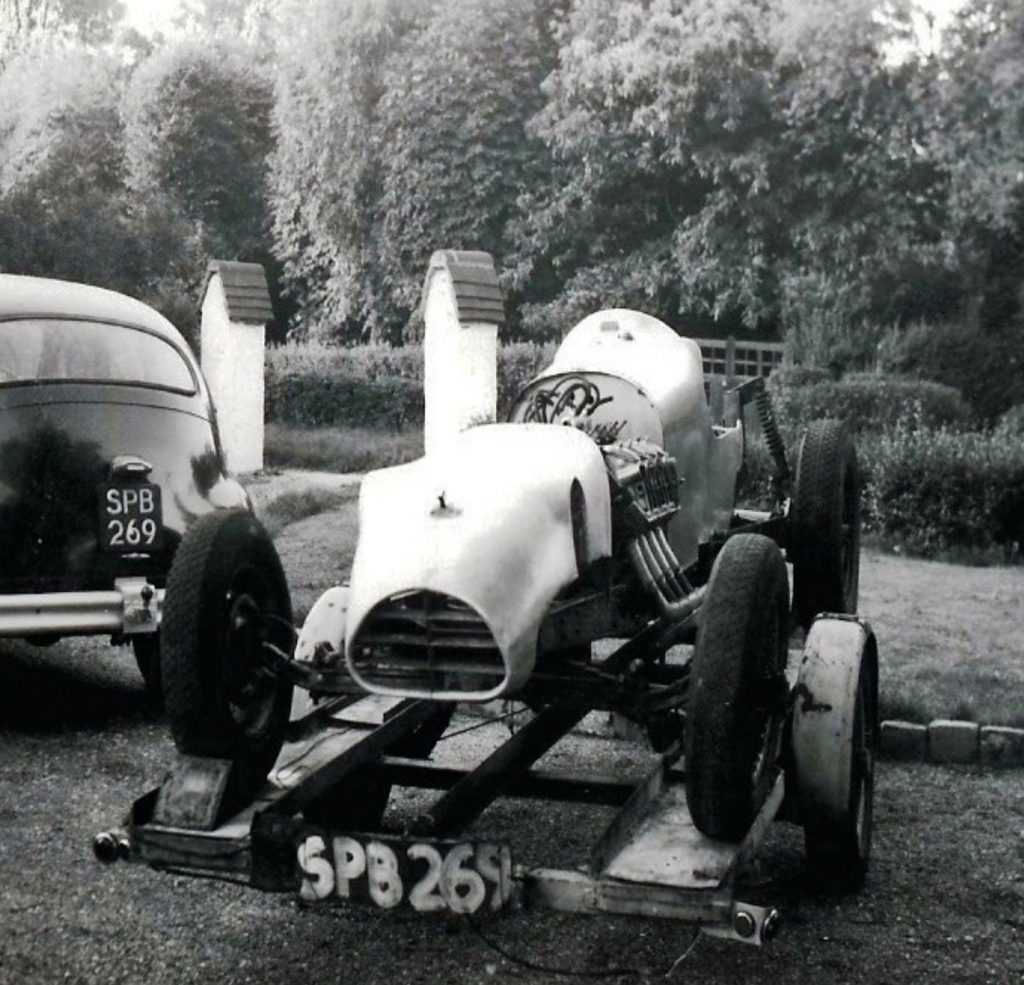
The Steyr as retrieved – prior to rebuilding