An order for some 20-ambulance rear axle conversions for Hong Kong suddenly arrived out of the blue. It was to be shipped in broken down form and assembled in Hong Kong. This sizeable order needed a considerable amount of work, including a full set of working drawings, plus assembly instructions. Sydney could best describe this like many jobs as “just a few sketches which would not take long”. In reality there was more than a month’s work to provide sufficient information for the Hong Kong authorities to carry out the conversion to the Austin LD2 chassis.
While this was a one-off order, we were led to believe that the conversions were carried out and worked satisfactorily. Soon after this order we had a request from the Yorkshire Ambulance authority to provide a rear axle conversion for the Austin LD1. This entailed a new design because the LD1 axle was smaller than the LD2, however something like 12 conversions were carried out.
While these ambulance conversions continued the LCC wanted us to explore the possibility of carrying out out an ambulance type conversion on a larger chassis, to be used for handicapped school children. While it was clearly possible, there was a need for design changes to the De Dion axle tube wall thickness and both front and rear springs. This project was actioned several years later and was for a total order of some 75 chassis.
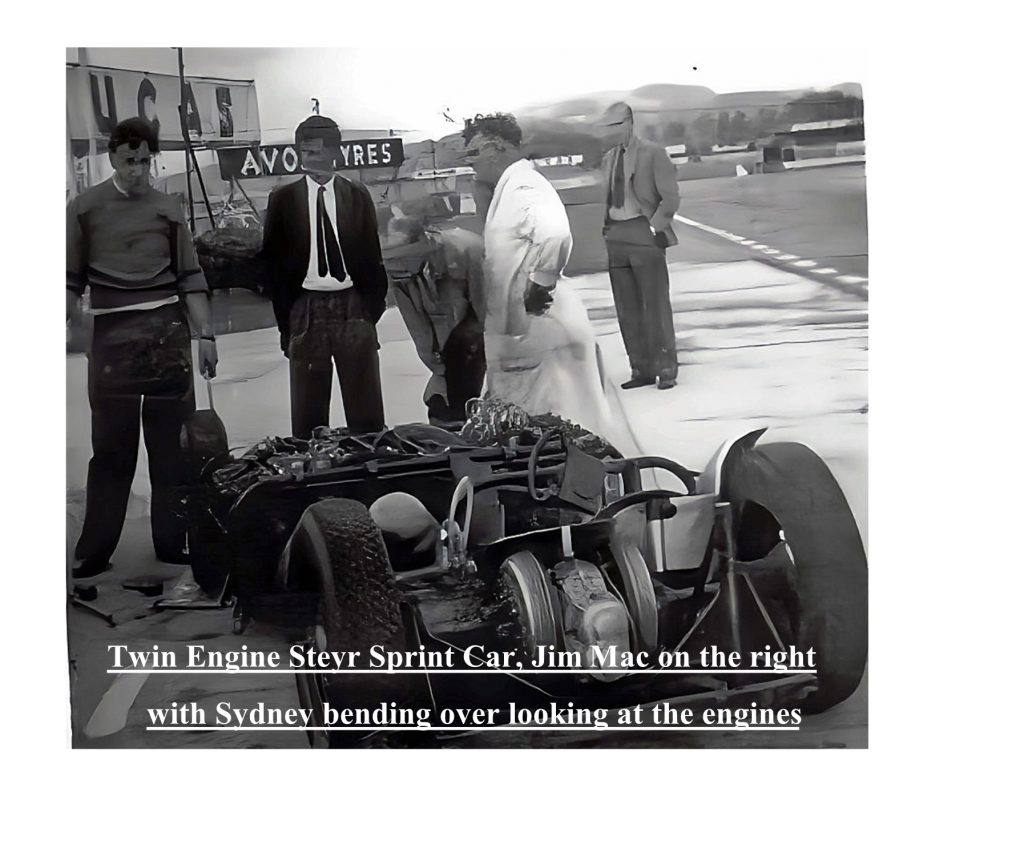
Work on the twin engine Steyr ‘Sprint Car’ continued to be carried with new drive shafts being made to mate up with the inner standard Hardy Spicer yoke coupling and the outer end splined to fit the fully floating hub arrangement of the De Dion axle of the Clark designed hill climb car. This was the same De Dion axle that had been used on the Steyr ‘Sports Car’. The front suspension originated once again from the Clark designed car, with double the engines, each developing no more than 200 BHP. A triple link chain of approximately 6” diameter and 0.75” pitch was used.
The gearbox outputs was splined to pick up on the gearbox output shaft with an additional outer steady bearing. The chains from each gearbox being connected to a central sprocket assembly. The whole assembly was encased in a 3/16” chain guard, and while I had severe reservations on the reliability of this drive assembly it did not give any trouble in the limited time it ran.
As ever this project was running out of time and with some two weeks to go before the Brighton Speed Trials the car was far from complete and had yet to turn a wheel in anger. In the week before Brighton it was taken, I believe, to North Weald where the engines were run.