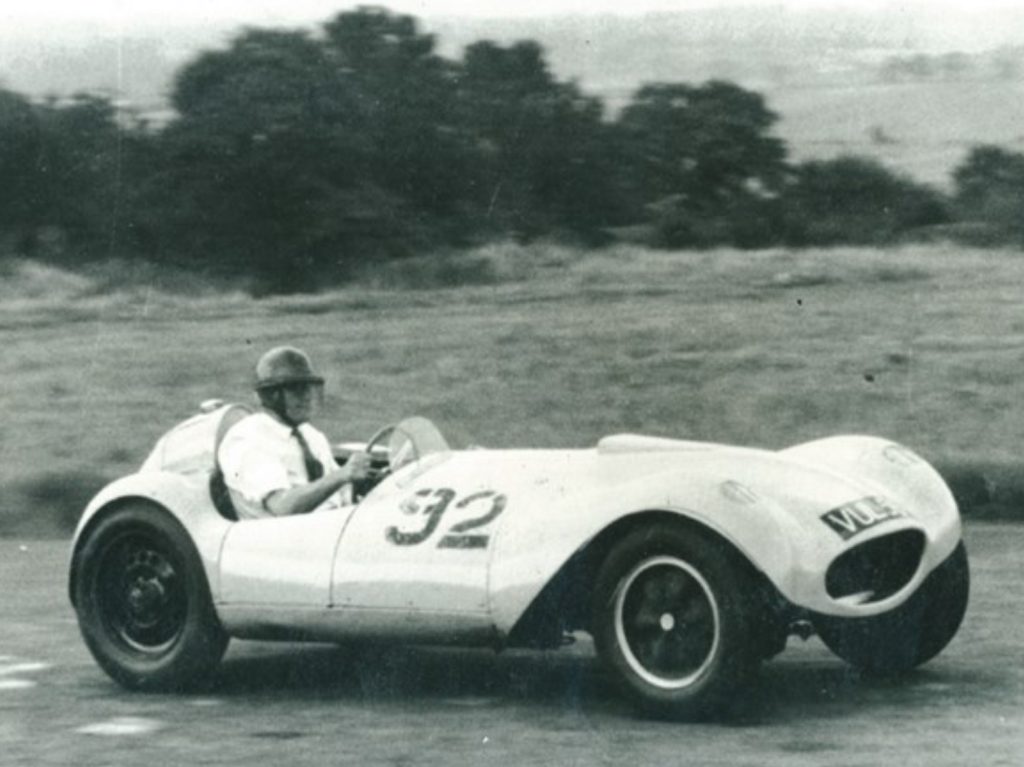
During this time the Steyr ‘Sports Car’ was run at selected meetings and in between it was taken to Silverstone where we set up a timed quarter mile section on the old club straight. We borrowed the BARC timing equipment and had several sessions of timing the car against the clock. With the quick-change axle it was possible to change the rear axle ratio and get the best out of the car. It was on one of these testing sessions that a con rod failed wrecking a very nice engine. Prior to running it that day, it had been noticed that there had been a fall in oil pressure but instead of calling it a day the engine continued to be run with dire results.
When it was stripped it was found that a small 6mm bolt had come out of the camshaft front bearing housing. Tracing back the oil galleries it was found that the camshaft ran in a chamber, which had it’s oil supply direct from the main oil galleries. From this gallery oil was supplied via the push rods to the rockers and while it had always been recognised that the oil supply came via the camshaft gallery it was not thought to be at high pressure. The argument that the fall in oil pressure was a miss-reading of the oil gauge was proved to be a very empty argument!
The failure had been due to lack of oil resulting in a ventilated block and a shattered con rod. The con rods on this engine were aluminium and had a generous section, however the cost of making another set of like con rods was not considered viable, so one of several engines lying about Clapham High Street was rebuilt. A set of special Allard produced cylinder heads, with larger valves and Grand Prix Amal carburettors were fitted. One of the potential failure items on the crankshaft was the counter balance weights, which were bolted on.
As I remember the failed engine had these weights bolted on with larger securing bolts. The replacement engine used the standard Steyr design but with new high tensile socket screws. The engine ran successfully however the carburettors tended to flood, essentially because the float chambers were probably slightly too high and did not have sufficient insulation from engine vibration. The car was taken to Goodwood for testing, however the staff (Alan Tiley) who took it down, decided to get it running before the ‘Guv’nor’ arrived and due to a hydraulic lock managed to bend a connecting rod.
The relatively easy operation of spinning the engine over, with the plugs removed, vintage radial aircraft style, would have avoided this damage. With a large number of spares back a Clapham I drove back, and got two spare connecting rods.
The Steyr with its separate cylinder barrels and heads made it easy to replace the bent connecting rod and about half an hour before the track closing time we got the engine running again. It did not run particularly well, mainly because the carburettors tended to flood.